









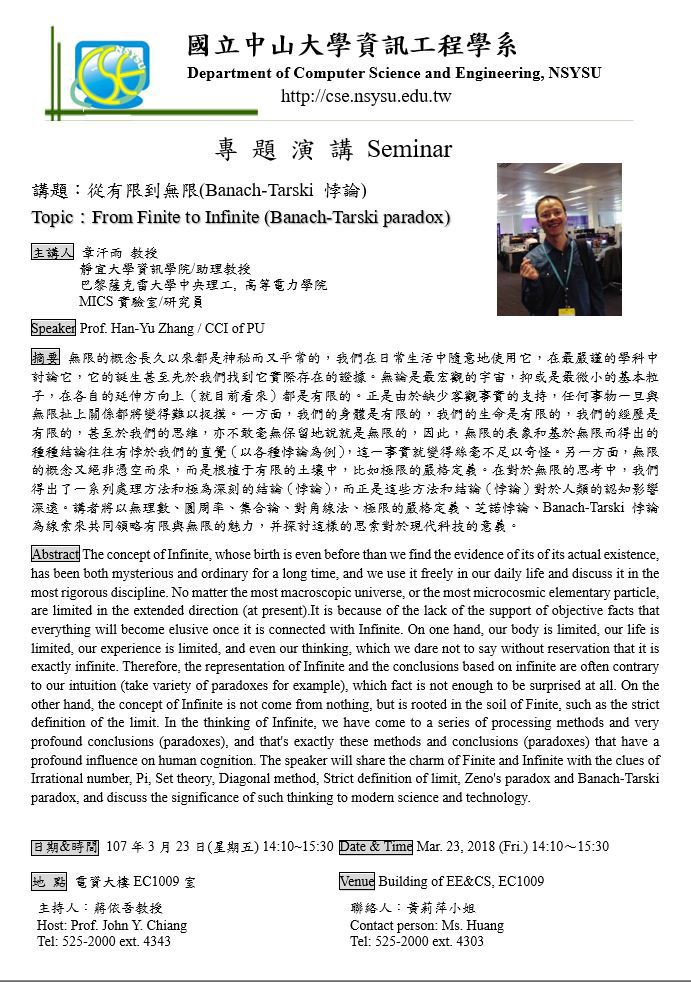
從有限到無限(Banach-Tarski 悖論) / From Finite to Infinite (Banach-Tarski paradox)
演講摘要:
無限的概念長久以來都是神秘而又平常的,我們在日常生活中隨意地使用它,在最嚴謹的學科中討論它,它的誕生甚至先於我們找到它實際存在的證據。無論是最宏觀的宇宙,抑或是最微小的基本粒子,在各自的延伸方向上(就目前看來)都是有限的。正是由於缺少客觀事實的支持,任何事物一旦與無限扯上關係都將變得難以捉摸。一方面,我們的身體是有限的,我們的生命是有限的,我們的經歷是有限的,甚至於我們的思維,亦不敢毫無保留地說就是無限的,因此,無限的表象和基於無限而得出的種種結論往往有悖於我們的直覺(以各種悖論為例),這一事實就變得絲毫不足以奇怪。另一方面,無限的概念又絕非憑空而來,而是根植于有限的土壤中,比如極限的嚴格定義。在對於無限的思考中,我們得出了一系列處理方法和極為深刻的結論(悖論),而正是這些方法和結論(悖論)對於人類的認知影響深遠。講者將以無理數、圓周率、集合論、對角線法、極限的嚴格定義、芝諾悖論、Banach-Tarski 悖論為線索來共同領略有限與無限的魅力,并探討這樣的思索對於現代科技的意義。
Abstract:
The concept of Infinite, whose birth is even before than we find the evidence of its of its actual existence, has been both mysterious and ordinary for a long time, and we use it freely in our daily life and discuss it in the most rigorous discipline. No matter the most macroscopic universe, or the most microcosmic elementary particle, are limited in the extended direction (at present).It is because of the lack of the support of objective facts that everything will become elusive once it is connected with Infinite. On one hand, our body is limited, our life is limited, our experience is limited, and even our thinking, which we dare not to say without reservation that it is exactly infinite. Therefore, the representation of Infinite and the conclusions based on infinite are often contrary to our intuition (take variety of paradoxes for example), which fact is not enough to be surprised at all. On the other hand, the concept of Infinite is not come from nothing, but is rooted in the soil of Finite, such as the strict definition of the limit. In the thinking of Infinite, we have come to a series of processing methods and very profound conclusions (paradoxes), and that's exactly these methods and conclusions (paradoxes) that have a profound influence on human cognition. The speaker will share the charm of Finite and Infinite with the clues of Irrational number, Pi, Set theory, Diagonal method, Strict definition of limit, Zeno's paradox and Banach-Tarski paradox, and discuss the significance of such thinking to modern science and technology.
 Infinite-for-review.pdf